
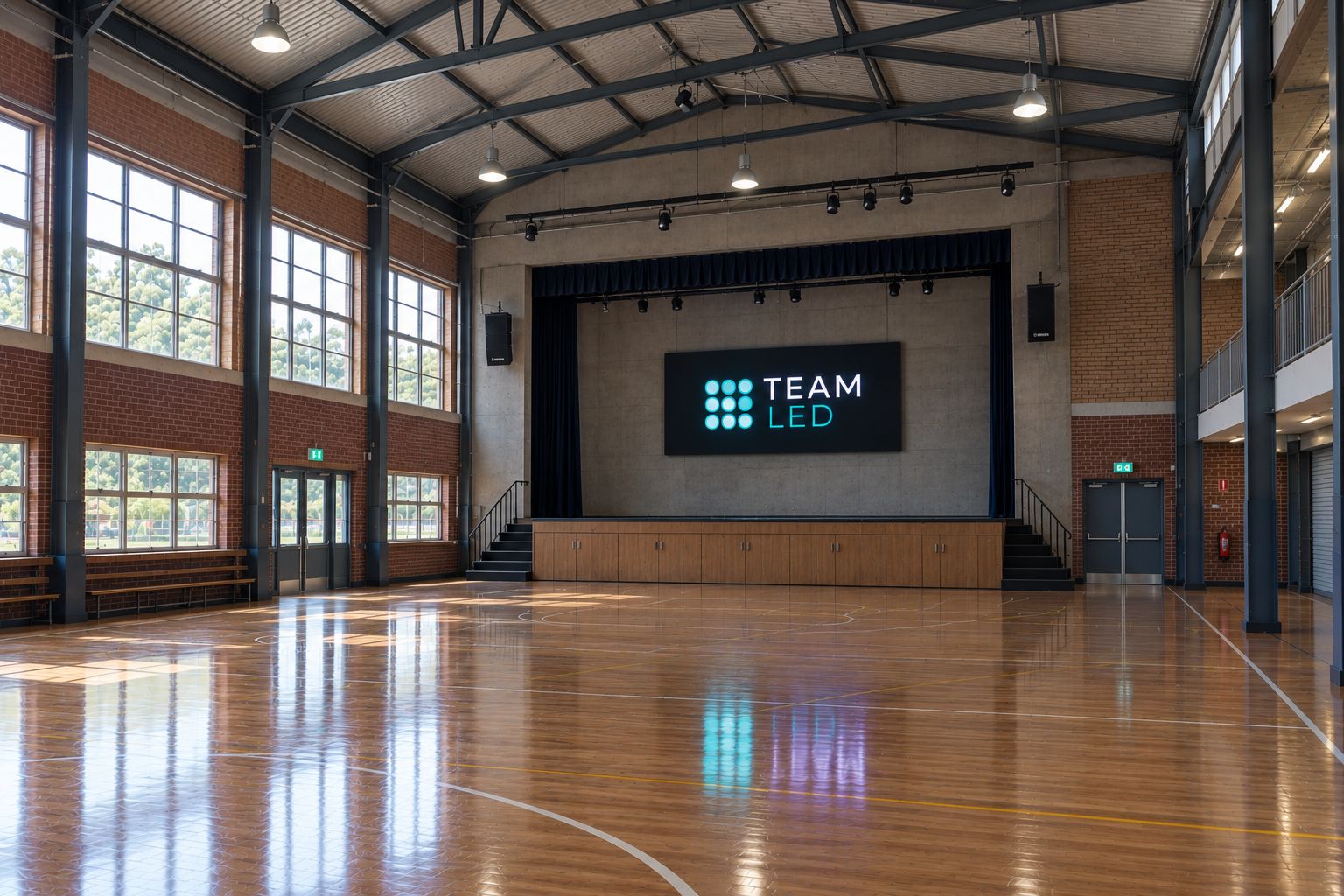
School Hall AV Buyer’s Guide
A practical guide for business managers, IT managers and facilities staff planning a new hall fitout or an upgrade to an existing one.
Buying AV for a school hall is a bit different from buying a TV. The display, sound, controls, mounting and wiring all have to work together in a big space, with changing light, plenty of background noise and years of daily use. Get one part wrong (a screen that washes out under the skylights, sound that doesn’t reach the back row, or a controller only the deputy principal knows how to use) and you’re usually looking at a second spend within three to five years.
This guide walks through what a modern school hall AV system includes, how to choose between display technologies, how to budget realistically and how the buying process usually works. It’s written for schools across South-East Queensland, Regional and Remote Queensland, and Northern NSW.
Education is our home ground, and this guide reflects how we approach the same questions when we quote a hall.
What does a school hall AV system include?
A complete school hall AV system covers five layers. Leave any one of them out and you end up with a partial fit that needs revisiting later.
- Display. An LED video wall (increasingly common for new builds) or a projector and screen (still a good fit in the right conditions). This is the part everyone sees.
- Sound. Speakers, amplifiers, a mixer or digital signal processor (DSP), and wireless microphones. Coverage has to reach every seat at an even volume.
- Control. A single touch panel or wall controller that lets a teacher, office staff member or student MC switch inputs, adjust the volume and turn everything off. This is where systems usually fail, so keeping it simple is a design decision, not an accident.
- Sources. Laptop and PC inputs, HDMI wall plates on the stage, wireless casting from a teacher’s device and Bluetooth audio, plus cameras for recording and streaming assemblies and performances.
- Infrastructure. Data cabling, power, mounting frames, rigging, and any structural or acoustic work the room needs to do its job.
A guide that only covers the screen isn’t really a system guide. We price, install and commission all five layers together.
LED or projector: which is right for your hall?
The biggest single decision is the display technology. Here’s the short version.
| Factor | LED video wall | Projector + screen |
|---|---|---|
| Coping with daylight | High (typically 800 to 1,500 nits indoors) | Low to moderate (needs blackout, or a 5,000+ lumen projector) |
| Image size | Modular, scales panel by panel | Fixed by projector throw and screen size |
| Viewing angle | Wide (170° or more) | Moderate, depends on the screen |
| Lifespan | 80,000 to 100,000 hours typical | 3,000 to 6,000 hours per lamp (laser projectors last longer) |
| Ongoing consumables | Very low | Lamp replacement every three to five years |
| Upfront cost | Higher | Lower |
| Five-year total cost | Comparable or lower once lamps and downtime are counted | Lower upfront, higher over time |
LED usually wins when the hall gets a lot of natural light, you want one install that lasts eight to ten years, or the hall hosts assemblies every day.
A projector can still make sense when the hall is only used a few times a term, the short-term budget is tight, or blackout blinds are already in place and you’re comfortable looking after lamps.
For more detail on this decision, see our LED vs projector guide.
What sound system does a school hall need?
Sound is where most halls fall short. The instinct is to buy a portable speaker and hope it covers a 300-seat room. It rarely does.
A permanent hall sound system needs to handle:
- Assemblies. Clear speech from the lectern microphone, reaching the back row at a comfortable listening level.
- Music playback. Backing tracks for choir, dance and drama.
- Several microphones at once. Handhelds for the MC, headsets for performers and a lectern microphone for staff.
- Spill outside. If the hall opens onto a covered outdoor area, coverage needs to stretch out there too, without doubling the number of speakers.
Every hall is different, so we design the speaker layout around the size and shape of your space. That means even sound from the front row to the back, with extra speakers added in longer halls so no one misses a word. We use well-established equipment with a long service life, so parts and support are still there years down the track.
Wireless microphones are matched to the size of your hall and how you use it, usually a mix of handheld, headset and lapel microphones. We’ll also help you choose a power option that suits your staff, including rechargeable systems that take the hassle out of managing batteries.
What does the control layer look like, and why does it matter?
The control layer is the biggest single factor in whether teachers actually use the system once we’ve handed it over.
A well-designed control layer means:
- One touch panel, mounted at the lectern or side of stage.
- Three to five preset buttons, such as Assembly, Presentation, Movie and Off. No menus.
- Automatic input switching, so the panel knows what’s plugged in.
- Volume up and down, and a microphone mute button.
A poorly designed one looks like a laptop connected to a receiver that a teacher has to log into, a mixer nobody is allowed to touch, and a projector remote living in a drawer no one can find. We favour control systems built around simple preset scenes rather than raw AV routing, because that’s what makes them easy for anyone to use.
If your current system relies on one particular person to run it, that’s a control layer problem, not a training problem.
School hall AV budget ranges
Cost depends on the size of the hall, the display technology and how complex the sound needs to be. As a rule of thumb, these are indicative ranges for a completed install (display, sound, control, installation and commissioning) in Australian dollars, excluding GST.
| Hall type | Indicative range |
|---|---|
| Small primary school hall (up to 200 seats) with projector and sound | $25,000 to $55,000 |
| Mid-size hall (200 to 500 seats) with LED wall, full sound and control | $65,000 to $140,000 |
| Large secondary school hall (500 to 1,000 seats) with LED video wall, full sound, control and delay speakers | $120,000 to $260,000 |
| Auditorium or performing arts space (1,000+ seats) with large LED wall, concert-grade sound and lighting integration | $220,000 to $500,000+ |
These ranges are a guide only. Ceiling height, existing cabling, structural mounting and whether the hall needs acoustic treatment all make a big difference. Every hall is quoted from its own drawings and a site inspection, so use these numbers to size a business case rather than to lock in a figure.
How do schools usually buy hall AV?
Most Queensland schools buy AV through one of four routes, depending on the size of the project and whether the school is state, independent or Catholic.
- Standing offer arrangement. State schools can buy through an existing panel arrangement. This is often the quickest route for smaller installs.
- Request for quote. Below the tender threshold, two or three suppliers quote against a written scope.
- Open tender. Above the threshold, or when the school board prefers it. A full tender process often takes 8 to 12 weeks.
- Capital works. For new halls or major refits, the AV is often scoped into the head contractor’s package.
Whichever route you take, ask for documentation you can actually work with: an itemised scope of works, warranty terms, safety documentation, product datasheets and drawings marked up against your floor plan. If a quote lands on your desk as one line that says “AV install $X”, that’s a red flag. Your business manager needs to see the ingredients, not just the meal.
What’s a realistic install timeline?
For a straightforward sound and control upgrade of an existing hall with cabling already in place, allow three to six weeks from purchase order to commissioning. If the project includes an LED wall, the wall sets the timeline: LED walls are made to order and can take 10 to 12 weeks to arrive from the manufacturer, so allow three to four months. That usually breaks down as:
- Site measure and final drawings: one to two weeks
- Equipment lead time: two to four weeks for sound and control equipment, and 10 to 12 weeks for an LED wall
- Installation on site: three to ten days
- Commissioning and staff handover: one day
For new builds, or halls that need structural mounting frames, add four to eight weeks. School holidays are the preferred install window, so it pays to book them in the term before.
Five-year cost of ownership
Upfront cost is the number that gets the most attention in a business case, but the five-year cost is the one that matters. Here’s what to add to an upfront quote to get an honest total.
- Consumables. Projector lamps ($400 to $1,200 each), microphone batteries and replacement cables.
- Servicing. Firmware updates, calibration checks, microphone checks and sound system tuning. Typically $1,500 to $4,000 a year for a mid-size hall.
- Warranty extensions. LED wall warranties usually run two to three years, and extending to five years is worth pricing.
- Component replacement. Wireless microphones and receivers usually need repair or replacement within five to seven years.
- Staff training. Budget one refresher session a year, in person or by video.
A hall that skips servicing usually finds a fault the week before graduation. Building servicing in from year one is the cheaper path, and our service level agreements are set up to make that easy.
Frequently asked questions
What is a school hall AV system?
It’s the display (LED video wall or projector), sound (speakers, amplifiers and microphones), control (a touch panel or wall controller), sources (laptop, wireless casting and media inputs) and infrastructure (cabling, mounting and structural work), installed together so the hall works for assemblies, presentations, performances and events.
How much does a school hall AV system cost in Australia?
A small primary school hall with a projector and sound system typically runs $25,000 to $55,000. A mid-size hall with an LED wall, full sound and control is typically $65,000 to $140,000. Large secondary halls and auditoriums with LED video walls run from $120,000 to $500,000 or more. The final price depends on hall size, ceiling height, existing cabling and acoustics.
Should we choose LED or a projector for our hall?
LED tends to win when the hall gets a lot of natural light or is used every day. Projectors still make sense for halls used occasionally, where blackout is available, or where the short-term budget is tight. Once lamp replacements are counted, the five-year cost is often similar.
How many speakers does a school hall need?
It depends on the size and shape of the hall. We design the speaker layout around your space so the sound is even from the front row to the back, adding extra speakers in longer halls so no one misses a word.
What should a request for quote include?
An itemised scope of works (display, sound, control, cabling and mounting), product datasheets, a marked-up floor plan showing speaker, display and control positions, warranty terms, safety documentation, an install timeline and a price for each line item.
How long does a school hall AV install take?
For a straightforward sound and control upgrade with existing cabling, three to six weeks from purchase order to commissioning. LED walls are made to order and can take 10 to 12 weeks to arrive from the manufacturer, so a project with an LED wall usually takes three to four months. New builds or halls that need structural mounting frames run eight to fourteen weeks. School holidays are the preferred window and usually need to be booked the term before.
What’s the difference between a projector and an LED video wall?
A projector throws an image onto a screen using a lamp or laser, and needs controlled light for a clear picture. An LED video wall is a modular, self-lit panel array, typically 800 to 1,500 nits indoors, so it stays clear under skylights and open blinds. LED walls last 80,000 to 100,000 hours, while projector lamps last 3,000 to 6,000 hours each.
What warranty and support should we expect?
LED walls typically carry a two to three year warranty, with extensions to five years available. Sound and control equipment carries the manufacturer’s warranty. Ongoing servicing (calibration, microphone checks and firmware updates) is usually arranged separately at $1,500 to $4,000 a year for a mid-size hall. Ask for a written service level agreement, not a verbal promise.
Can we upgrade our hall in stages?
Yes. A common path is the display and controls in year one, sound in year two, then extra wireless microphones and streaming in year three. The key is designing the year-one controls with room to grow, so stage two doesn’t mean replacing the controller.
Talk to Team LED
One team handles the whole job, from design to commissioning. Tell us about your venue and we’ll take it from there.